
The field

“A large city with diverse characteristics”

Location:
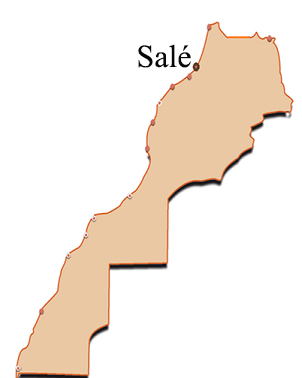
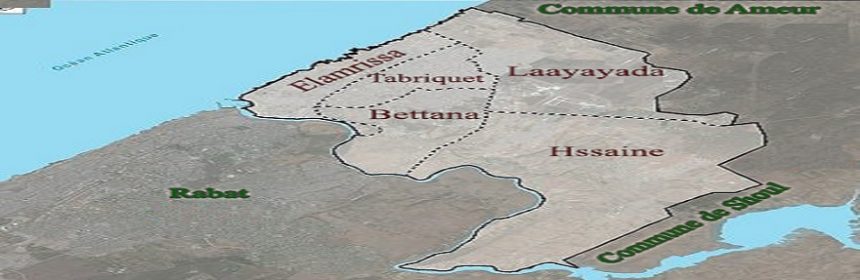
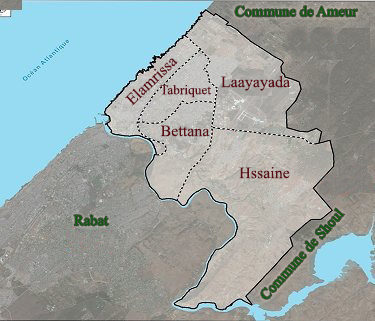
Sale city is located in the region of Rabat –Sale-Kenitra  on a global surface estimated at 95,48 Km2 ,it is limited from the east by Province khemisset, from the south by prefecture Rabat, from the west by the Atlantic ocean, and from the north by the Province  of Kenitra.

The climate:

Sale belongs to a nearly wet climate, with changes from nearly dry to wet. Because of the influence of continental and sea currents, the average of rain falls is between 500 and 600 ml a year. And the rain period lasts between October and March, whereas the dry period from April to September, it varies between 8° in winter and 30° in summer. Snow almost never falls.

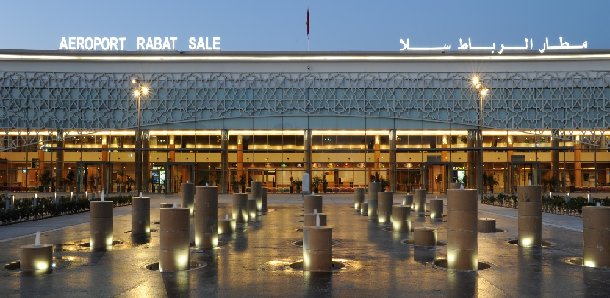
Internationally, Rabat Sale airport is a gateway to the external world .And the existence of the city on the Atlantic coast is an important factor giving a real opportunity to set up a sea outlet on the world.

The tramway project strengthens the net of urban traffic:

Urban transport has a big importance for the city inhabitants, either in the urban axis of Sale or outside it, especially that a large number of inhabitants move daily to Rabat. For this reason the tramway  project , which is part of the management  of the banks of Abu Regreg river, enables to join Sale with both Rabat and Temara. The first line puts together Tabrikt in Sale with neighborhoods of university and medical institutions in Rabat, whereas the second line joins neighborhood Betanna in Sale and neighborhood the ocean in Rabat.
Water as a vital substance is available in a sufficient way

The forest field of Mamora stores an important water fortune in the form of a water bed  which takes its sources from the south then gets larger to the North , North east and north west. This water bed can be divided into three parts. One of them ,which is called coastal concerns Sale city, and it covers a surface estimated at about 390km2.

Abu Regreg  river constitutes another source to provide the city with water through Sidi Mohamed Ibn Abu Abdellah dam. That’s why providing enough water for Sale city doesn’t present any problem in the current time.

Maamora  forest:
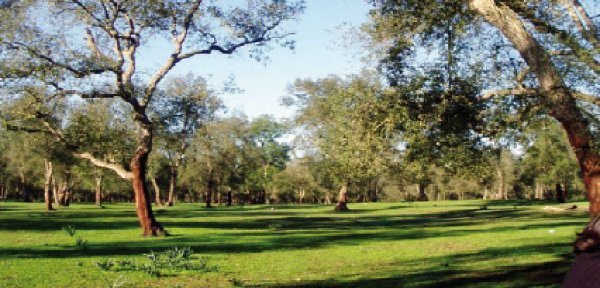
Maamora forest goes along Sale city in its North Eastern frontiers. And it is formed basically from oak trees  which are considered a real lung to the whole wilayah and an oxygen reservoir which plays a major role in the ecological equilibrium  of the region . The flora of the forest also plays an important role in protecting the water bed .This forest has always constituted a natural recreation to the city inhabitants ,to their relaxation and sightseeing.

Sale, an ancient historical heritage and a diversified natural context:

Surrounded by historical walls along 4,3Km, the old city of Sale presents a group of landmarks which reflect its historical richness, among them: the Merinid school founded by Abu Alhassan Almarini  which opened its doors in front of people after its restoration, historical gates like Gate Elmerissa, Gate Fes, the fountains, canals for bringing water, the market of arches, Alqissariyah,the market for weaving, Dar Albaroud …all of them are squares and landmarks no tourist guide would fail to mention. Also ,the location of the city on the right bank of Abu Regreg river and on the Atlantic coast (with the presence of a rocky  beach ), besides its proximity to Maamoura river makes of Sale a city with interesting touristic potentials and promising prospects.

Traditional industry and textile industry are distinguished activities in Sale:
Concerning the activities of the inhabitants, the sector of public administration (in Rabat and Sale)is considered the first employer to the city inhabitants, followed by the sectors of industry, traditional industry and commerce.

Traditional industry is the most important sector in the city, Sale represents the third national pole in this field after Fes and Marrakesh. Kariat Alwlja is considered one of the places where we have a number of crafts, it includes hundreds of specialized traditional units, which were able during a few years to form a grouping of traditional Moroccan Arts.

In the sector of industry, textile takes the first position in the number of units, followed by chemical and pseudo-chemical industry then the sector of food industries.

Concerning the infrastructures meant to receive the industrial activities in the city, there are at the current time many industrial places in which many industrial units operate these are in: Tabrikt, Errahma neighborhoods, Ezzahra on the way to Ewalja, Sabihi on the way to Kenitra.

Tourism in Sale: real potentials to promote the sector:

Concerning tourism, the diversification of the natural field and the richness of the historical heritage of the city, both form real and promising potentials to promote the sector.

The operation of managing the banks of Abu Regreg river, with the projects it includes to set up new touristic structures, forms a new attraction factor for the city. The project of managing a new tourist station on the beach of nations(in Boulqnadel commune) will enable of setting up new structures(golf fields…) capable of attracting more tourists.

From another side, the sector of sea fishing as a traditional activity finds a promising opportunity to prosper especially with the project of managing the mouth of  Abu Regreg river, which also allows for new sea activities to evolve and develop.
Tramway Rabat Salé

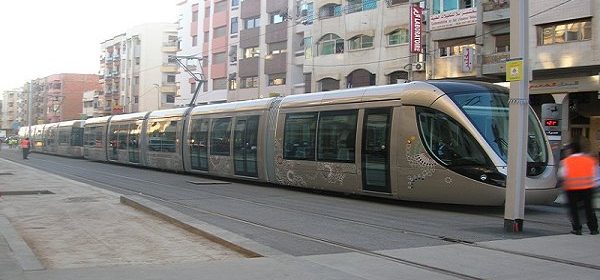
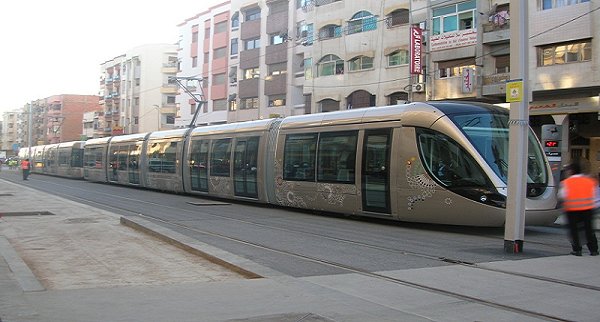
Tramway Rabat Sale is a system of transport through railways to serve inhabitants of the urban agglomeration of Rabat Sale.

This project which was inaugurated by his majesty Med VI on May 11th , 2011 is considered one of the convenient solutions to the problem of urban transport in the two cities since it satisfies  the increasing demand for transport  .It also provides a real alternative to using cars, and because it aims at simplifying the movement of traffic and circulation and rendering it easy to  Rabat Sale through adopting means of transport and traffic which respect the environment and guarantee the conditions of safety and organization at work.This project is one of those which gained priority in the context  of  managing and developing the banks of Abu Regreg.

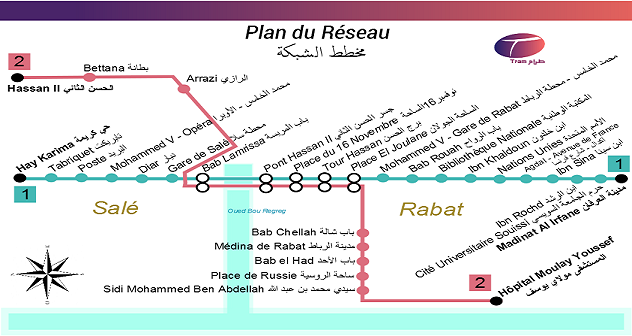
The current web of the tramway consists of two rails whose length reaches 19,5 km and which have 31 stations.

The web covers the most important urban poles that know a high population density of inhabitants and their movements (university neighborhoods, hospitals, administrations, the centers of the two cities, the important road and train stations).

Wagons used, and whose length reaches 32 m, are characterized with a design that respects international criteria and they have air conditioning equipments and  entrances for people with special needs.

The project whose launch of work was given by his majesty Med VI on December 23rd, 2007, was performed by the agency of management of the banks of Abu Regreg in partnership with the local communes of Rabat Sale. Starting from January 2009, the company of the tramway of Rabat Sale which incorporates among its contributors the commune of Rabat Sale the one which supervises   the work proceedings .   

The tramway works through two major lines:
  • The restructured line to the urban agglomeration from Karima neighbourhood  in Sale to Madinat Alirfane in Rabat on a distance of 11,7 km and it includes the major poles to the two cities through 22 stations and the period of the journey in this line lasts 36 mns.
  • A line special for the inhabitants of neighbouhoods with high population density, like Yaakoub Almansor in Rabat and Bettana in sale city through 14 stations and on a distance of 7,8 km, the time of the journey in this line lasts 25 mns.
  • The average of frequency of the tram in each section reaches 8 mns, whereas this frequency in the shared section from   Bab Lemrissa to Aljoulan square reaches 4mns. All the lines have two parts.

It is likely to extend the two current lines to reach new places in the direction of Temara, New Sale and other areas.

Developement of the Bouregreg Valley

The project of managing banks of Abi Raqraq River which cover a surface of 6000 hectares aim at managing the site  and  developing its space  with total respect to environmental conditions.This big project consists of six complementary parts especially Bab Albahr,Amwaj,Qasbah Abu Regreg,Sahrij Alwad,Almanzah Alkabir,Buhairat Assuhul.

At  the beginning ,work focused on the first and second parts:

The first part:

Bab Albahr is a place meant to be an entertainment center for Sale and Rabat inhabitants and this project is considered as the fruit of cooperation between the agency of managing the banks of Abi Raqraq river and the institution of The international Crossing for Investment in Abu Dhabi.

The amount of investment  in the project of Bab Albahr  is 7 billion dirhams  on a surface of 30 hectares. 530.000 m2 set for habitat blocks , hotels, services and public equipments, besides a group of entertainment poles in the space for  Arts and Crafts. And they are formed of the following projects:

1.Performing a subway project for the urban agglomeration Rabat Sale, whose official start was given by his majesty Med VI on December 23rd, 2007, and it is part of  a general strategy to  rehabilitate  urban public transport in the two cities. The length of the tramway rails 19km in 31 stations, and it includes two trails:

  • Rail number 1 : which is considered the basic line of  the project, it goes from Karima neighborhood in Sale to Madinat alirfane, and Hospital Ibn Sina in Rabat, moving through important places in the cities: Avenue Med V in Sale, Mohamed V, Alwizarat and train stations,( Sale city, Rabat city) and universities.
  • Rail number 2: Joins Almohit Neighbourhood   and   Yaakoub Almansour (Hospital Moulay Yousef) with neighbourhood  Bettanna   in Sale passing through Bridge Moulay Elhassan on Abi Raqraq river.

2.Building the new Bridge Moulay Elhassan whose launch of work was given by his majesty Med V in 2007, it is distinguished on the one side by its special architecture and urban integration and on the other side by its huge shape ,hence it stretches along 1,2 km and it is formed of two parallel ways with three tracks for pedestirians and cyclists and a special track for tramway with two lines.

3.The project of Oudaya tunnel : it goes  from  Madarat  Bab Albahr in the direction of the Cemetery of Achouhada from the side of the sea along a distance of 1022 . The creation of this tunnel aims at solving the problems of traffic which Rabat and Sale city know and to alleviate the  pressure  and  jams in the old road.

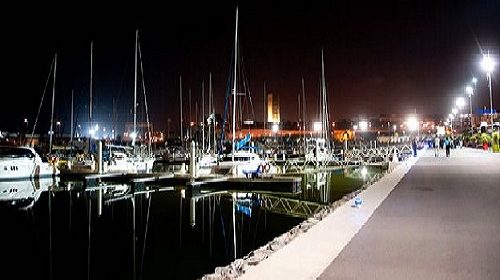
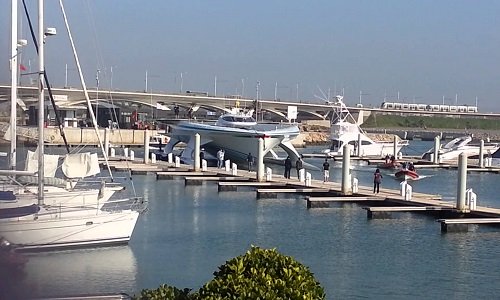
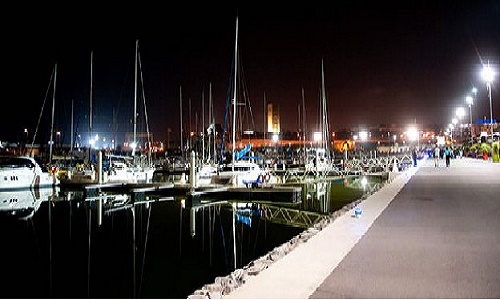
4.The entertainment post Marina Abu Raqraq is considered one of the important projects which form an important factor of attraction. Due to its extension on a surface of 8 hectares, it can receive 350 entertaining complexes, and it is surrounded by a number of restaurants , entertainment places ,houses ,high quality hotels and tourist places like the space of Hassan Minaret ,Bab Lemrissa and the old city of Sale.

The second part:

Taking into consideration its central location between the right and the left banks of Abu Raqraq river, and its role as a linking point between  estuary  Abu Raqraq and  Alwalja  plain, this part represents the major part  of the project and it is distinguished with a Mediterranean architectural design on a global surface of 112 hectares, set to establish  :

  • Luxurious hotels
  • Shopping places.
  • A museum.
  • A park of 10 hectares (between the theater and the bridge).
  • The large theater of Rabat with a special design on a surface of 27000 m2.

www.bouregreg.com

www.tram-way.ma

The modernization of communal administration

Digitizing the services of the civil status “an ambitious project to serve citizens” :

In the frame of efforts to modernize the communal administrative services directed to  citizens  , Sale commune started a comprehensive project to update the services of the civil status. To achieve this ,many deals were concluded related to rehabilitation of  the  administrative  bureaus  of the civil status and equip them with necessary tools and train functionaries responsible for these bureaus. The general objectives of the project revolve around  improving  the conditions of work of employees of these bureaus and presenting a better service for citizens through:

  • Managing the bureaus of the civil status by adopting the open space.
  • Equipping the bureaus of the civil status with the furniture of the bureaus and informatics equipment.
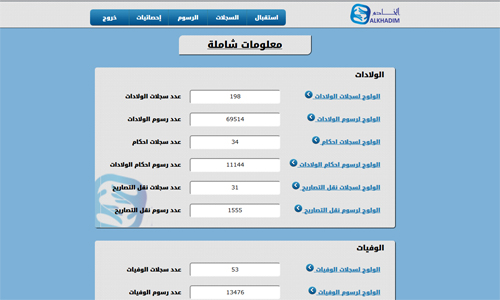
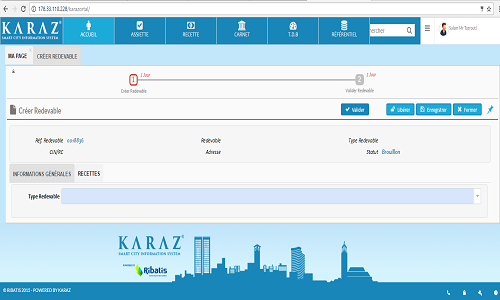
  • Digitizing civil status files ( more than five hundred thousand acts) and the adoption of a digital application to use them and the provision of an electronic data basis to the documents of the civil state in a way that adopts new technologies.
  • Providing the bureaus of the civil state with equipments to organize queuing and with surveillance cameras.
The adoption of a special informatics program for local taxes:

To develop its financial resources and to develop its private earnings through the promotion  of  material and human resources  to get local taxes, the communal council of Sale adopted a special informatics program which enables the agencies of earnings  in the commune and the other communal services related to it like the urbanization services and communal and technical services and others to list all the concerned people  and deal with their  files   and collect taxes  and this through an efficient automatic manner and with a total respect of  the deadlines and regulations  in effect.

This program will enable  to:

  • The general automation to manage  local  taxes .
  • Providing the necessary information for decision taking.
  • Quickening the operations and regulations of management.
  • Automatic control and follow up of different files.
The single window for  construction permissions with high professional qualities:

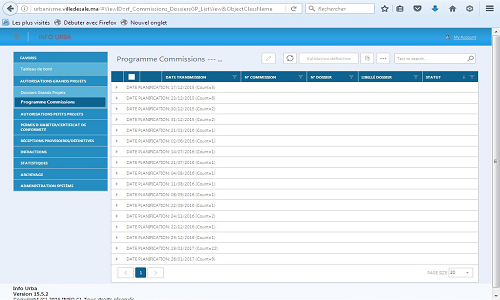
Accompanying  the  new  legal  developments  which the sector of urbanization knows, and which aim at providing the necessary conditions to develop it and guarantee its satisfaction to the needs of citizens and investors, through implementing   the policy of simplifying the rules and the steps of studying different projects, Sale commune set up  the single window  for the permissions of construction which the law decrees  according to the text number 2.13.424 issued on 24th may 2013, and which is related to agreeing on the general condition of construction  which determines the shape and the conditions of submitting permissions and the documents needed according to the legislation rules related to construction and real estate and  the division of real estate and the issued texts to apply them.

The single window for  permissions of construction is considered the only  interlocutor  to those concerned. It takes care of  following the track of applications starting from the time of submission to getting permissions, and for this purpose, it puts under their disposition all the necessary information related to the documents needed for the files of permission  demands  and  the regulations and ways of giving them and the processing situation of studying those files. It was constructed with modern architectural characteristics and it is equipped with all the assisting means of perfect management of the files of permission demands and the good reception of citizens. In addition, it was also equipped with a modern numerical system determining long distance reception appointments  and receiving and dealing with  demands of different  permissions in an electronic manner.

Adoption of a strategy and a planning for communication : For an efficient communication to a civic commune:

In the context of promoting the level of communication be it internal or external ,  since it is considered an essential pillar to communal work and bridging gaps and guaranteeing interaction with partners and enabling inhabitants to information and assuming their obligation in suggesting and evaluation , the commune of Sale , under the frame of the agreement it signed with the program of local governance, prepared a strategy and a planning of communication specific to the commune and its five districts, and which enables organizing and institutionalizing communication operations on all levels.

A work team formed of a group of employees of the commune and districts under the supervision of an expert charged from the program was charged of shaping  a strategy of communication based on the institutional , legal and constitutional references which stressed on the right of citizens  to access to information and on the role of communication in simplifying the management of general  local affairs .

The period of preparing this strategy was an occasion to diagnose the situation of communication in the commune through focus on weakness and strength points and also the challenges and opportunities which are considered as starting points which help in shaping a work plan to control  an efficient communicational relationship between concerned parts.

In application to the strategic vision of communication which form the essential core of  communication operation, the commune adopted a realistic communicational plan for a period of three years which includes  82  pragmatic  measures  .

Creating a section for informatics and communication systems:

The new systems of information depending on new technologies in mass media and communication have become an essential pillar to modernize communal administration and compatibility with the public policy in this field which aims at moving to a general electronic administration, a special sector for information systems and communication was created to take part in this development and keeping up with it.   

This sector  especially  takes  care of supervising  the development and performing informatics applications and systems suitable to different communal services according to the regulations in effect, and the preparation of data bases to enable users of precise information which enable them of good management of  the local situation. The service also works on managing the informatics of the commune ( equipments, webs…) and maintaining them and  taking measures  to protect them from dangers, besides presenting different forms of support  and assistance to the users of equipments and informatics programs, and  generalizing  the services of  electronic  communication on all the functionaries  of communal  services.

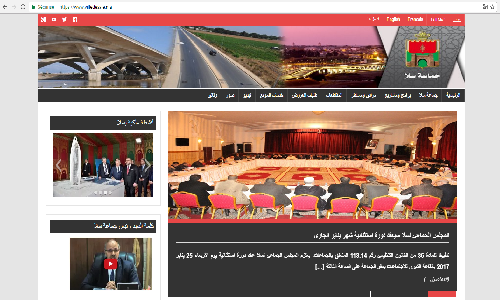
It also takes care of preparing and coordinating different operations of internal and external communication addressed to the public and to mass media and to different partners by depending on necessary means to cover different activities of communal services through preparing and publishing  pamphlets  and  periodicals  and continuous updating of the  content  of electronic  website of the commune and other communicational means.

Creating a special cell to follow up citizens  complaints:

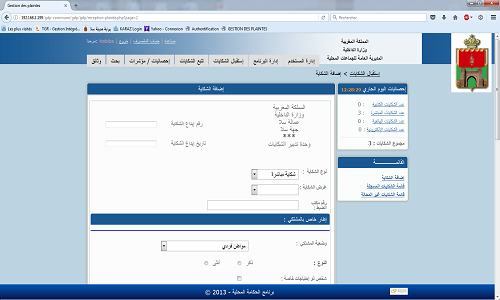
The issue of managing complaints takes a big importance from the side of the communal council of Sale since it has a direct effect on the relationship between the administration and its people. For this purpose, the communal council of Sale created a cell which takes care of presented complaints according to criteria agreed  upon  and through a specific methodology  in  answer   to  citizens expectations and therefore the effective contribution to achieve good governance to communal administration and improve its services.

The cell receives citizens complaints addressed to the commune either in a direct way or through the central  bureau  of  control  or through the service meant for that in the electronic window of the  commune , and it studies them  ;follows their course and result  in coordination with all the concerned services and communal sectors. And for this purpose, the cell participates in diagnosing and attending to term meetings in the office of the general secretariat or in the administration annex  under whose territory  the  complaint takes  place .         

Strengthening  internal control through creating a section for examination:

For the sake of consolidating the control of administrative work , the implementation of projects , and the evaluation of works and activities as an embodiment   to the rules of good governance , there was the creation of the  service of internal investigation whose task is to activate the terms of reference  of control given to the head of the communal council, and it contributes through the works of evaluation it applies and the recommendations it issues in the efficient guidance of the commune , and for that it prepares the plans of internal investigation and updates  the map of the risks of the commune and gives close attention to  the implementation of the tasks of  control and examination   and to  preparing reports about them and  follows the  course of the activation of recommendations issued  from the unit of internal investigation or the external institutions of control and examination together with  preparing the plans of formation and finishing expertise for the benefit of the employees of the sector and  updating  the program of promoting excellence meant for  the activities of investigation.

The Bureau

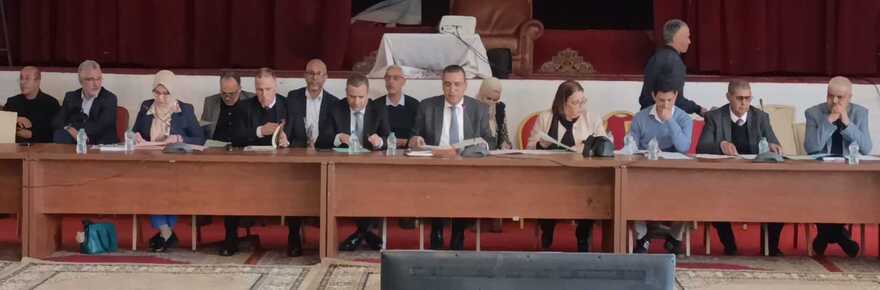
According  to the  implications  of  the  law  number  14 . 113 related to the commune, the bureau of the communal  council of Sale is formed of the  head  and  10  member  deputies  and they  are  all elected during the deputizing period of the council.

The bureau is responsible for controlling the agenda of the council meetings  and the deputies supervise the implementation of decisions,  each  in  the field deputized to them.

The bureau meets by an invitation from the president once in fortnight, and meets in case of necessity by an initiative from the president or from a written invitation from 1/3 of the bureau.

The meetings of the bureau are attended by the secretary  and his deputy and the bureau can also invite the heads of the committee if the points listed are related to their fields of interest.

The meetings of the Bureau are directed by the president and in his absence his deputies respectively do that, and the bureau of Sale is formed of the following names:

Jamaâ El Mouâtassim
Rachid Douibi
Abed Touiger
Bahaeddine Akdi
Elmostafa Ghomarie
Mohammed Laâlou
Abdellatif Soudou
Mustapha Jawadi
Said Gamal
Halima Chouika
Hicham El Hassani

Terms of reference of the commune

Terms of reference of the commune 

The commune is responsible within its territory of presenting close service to citizens according to the terms of reference  assigned  by  the  organizational law for communes and this through  organizing ;coordinating and follow-up. And for this purpose it exercises   private terms of reference and shared ones with the government , and others  assigned  by  the last.

These include terms of reference assigned to the commune in a specific field, which enables the commune, according to its resources, and within its territory, to perform   specific  duties  especially planning, programming, performing management and maintenance.

The action program of the commune

Under the supervision of the head of its council, the commune puts its action program and works  on implementing , modifying and evaluating it. And this program includes the developmental works meant to be accomplished or contributed at within the territory of the commune during six years, and it includes a diagnostic of the needs and the potentials of the  commune , and it fixes its priorities , evaluates its resources and approximate expenses for  the three first years and takes into consideration gender approach.

Public communal facilities and equipments:

The commune creates and manages the necessary public facilities and equipments to present proximity services in the following  fields :

  • The distribution of tap water  and 
  • Urban public transport.
  • Public electrification.
  • Stations for recycling used waters and liquid cleansing.
  • Cleaning streets and public squares, collecting domestic garbage and similar things and transporting them to excretory waste and appraising them.
  • Transit and wandering around and marking public roads and parking.
  • Health protection.
  • Creating and maintenance of cemeteries.
  • Communal markets.
  • Handicraft fairs and evaluating local products.
  • Places for selling cereals.
  • Road  Stations  for  transporting 
  • Rest stations.
  • Creating and preserving natural parks within the territory of the commune.
  • Centers for camping and summer camping.

With the help of other agents from the public or the private sectors, the commune also creates and manages the following sectors:

  • Whole sale markets.
  • Butcheries and slaughtering and transporting meat.
  • Markets for selling fish.

Construction and terrain preparation:

With consideration to the laws and rules applicable in the sector of urbanization, the commune is concerned with what follows:

  • Ensure respect for the choices  and  rules  taken  in  the  schemes  of  urbanization management  and all other documents related   to  terrain preparation and construction.
  • The study and approval of the construction regulations in accordance with the laws and regulations in force.
  • Implementing the requirements of conditioning design and the project of rural development regarding the opening of  new areas for reconstruction according to the conditions and modes determined by law.
  • Put an addressing system related to the commune, whose content and method of preparation and updating are determined by a decree issued by the suggestion of the governmental authority in charge of the interior.

International  collaboration:

The commune can conclude partnerships with agents outside the kingdom in accordance with international cooperation, and can also get financing in the same context after the agreement of public authorities according to the laws and rules in effect.

It is not possible to conclude any partnership between the commune or the institution of collaboration between communes or the group of territorial communes and a foreign country.

Shared  terms  of  reference

Shared terms of reference between the state and commune include the terms which show that the efficacy of exercising them  is done in group, and these terms are applied in a contractual way, either through an initiative from the state or from a demand from  the commune, also these terms can be  practiced  according to the principles of gradual advancement and differentiation and they include the following fields:

  • The development of the local economy and promotion of employment.
  • The preservation and the development of the specificities of the local cultural heritage.
  • Taking the necessary steps to promote and encourage the private investments, especially performing the infrastructures and equipments and the contribution in setting up areas for economic activities and improving the conditions of work of enterprises.

For this purpose, the commune can contribute in carrying out  the following tasks:

  • Creating houses of youth.
  • Building up nursery schools and kindergartens.
  • Creating centers for women.
  • Creating houses for charity work and hospices.
  • Creating social centers of housing.
  • Building up entertainment centers.
  • Creating cultural complexes.
  • Setting up public libraries.
  • Creating museums and theaters and institutes for arts and music.
  • Creating sport complexes and plazas and sport stadiums and covered halls and sport institutes.
  • Creating swimming pools and cycling fields, horse racetrack and camel racing.
  • Environment preservation.
  • The management of the coast located under the territory of the commune according to the laws and regulations in effect.
  • Management of the beaches and the coastal lanes and the lakes and the banks of rivers which are inside the territory of the commune.
  • Maintenance of the schools and schools of basic education.
  • Maintenance of health posts located under the territory of the commune.
  • Maintenance of the national routes which cross the center of the commune routes and its urban field.
  • Building and maintenance of communal routes and paths.
  • Rehabilitation and tourism valuation of old cities and touristic landmarks and historical sites
Transferred  terms  of  reference

The  field  of  transferred  terms  of  reference from the state to the commune are defined with consideration to the principles of gradual advancement and differentiation between the communes and include especially the following fields:

  • Protecting and restoring historical monuments and cultural heritage and the preservation of natural sites.
  • Creation and maintenance of small and medium  water  establishments  and equipments.
1 36 37 38